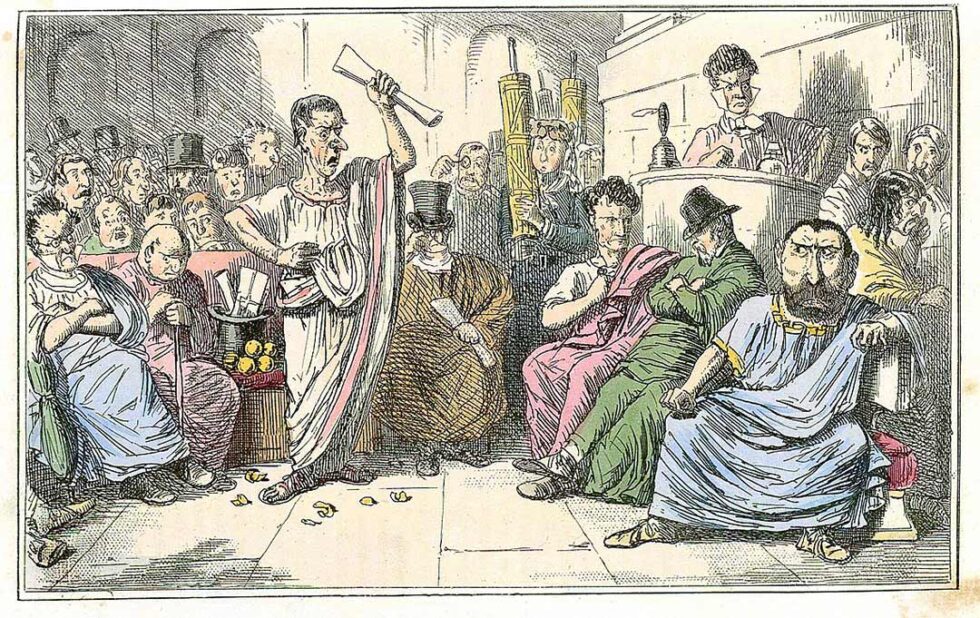
Cicero denouncing Catiline for trying to overthrow the republic
Against The Unity in Action Commission: Democracy Is a Practice, Not a Brand
I am an independent member of this chapter, not in any caucus, and I have been since April of 2025. I say that upfront because I want it to be clear that what I write now comes from someone with no factional loyalty. My only real and true commitment is to the democratic socialist project we claim to share.
A resolution so titled, “The Unity in Action Commission,” asks us to hand over the most fundamental and pressing questions facing our chapter to nine people. These questions are: How we vote? How we organize? How we communicate? How we govern ourselves? Nine members, elected in a single STV vote, deliberating for over a year, with the authority to enter closed sessions at will, who then present at convention a bundled package of structural reforms. We are being asked to trust that this body will represent all of us.
For several reasons, which I will lay out clearly in this article, I do not trust that. Moreover, I wholeheartedly believe that if we are honest with ourselves about the dynamics of this chapter, we simply cannot trust it, and must now begin to ask fundamental questions about chapter leadership, unchecked caucus activity, and how we have gotten to this point.
The Whereas Tells on Itself
Oftentimes the whereas is glossed over by readers of a resolution, viewed as extra wording to get through before reaching the real meat of the therefore. This should not be done. The whereas clause tells you several things about an author: their politics, allegiances, shortcomings, desires, philosophy. This UIAC resolution is no exception. There are several lines in the whereas clauses that attempt to shift the narrative, recasting the author from a figure of chapter leadership and engine of factional division into an honest, unifying leader. I find this truly troubling for several reasons, the main one being that it hides the truth.
The resolution celebrates One Member One Vote as a democratic triumph, writing that "our organization's democratic commitment to the principle of One Member, One Vote reflects our fundamental belief that decisions must be made by our full membership, not just by a subset of insiders who show up to a given meeting." And yet it proposes nothing, absolutely nothing, to address the ways OMOV has stagnated deliberative decision-making among active members. The resolution claims in Whereas 16 that "an incomplete and somewhat chaotic series of communications platforms in the chapter (Slack, Whatsapp, etc) has exacerbated some of the aforementioned problems." They have not. What has exacerbated problems is when members try to address real issues in those spaces and are met with grievance filings instead of good-faith engagement.
And then there is Whereas 12: "Metro Detroit DSA is a strong multi-tendency chapter which currently lacks a clear center of gravity when it comes to collective action in carrying out democratic decision making." If you understand the tendency dynamics here, you hear what that means: a desire for centralized authority, a permanent leadership class that decides when, how, and why the chapter acts. That is not democracy. That is consolidation dressed in democratic language.
The Problems Are Real. The Source Is Being Hidden.
Let me be clear: the issues this resolution names are real. Siloization is real. Communication chaos is real. Insufficient democratic infrastructure is real. I am not here to deny any of that. What I am here to say is that this resolution diagnoses symptoms while carefully avoiding the disease.
The same caucus that authored this resolution has controlled our Steering Committee for years. Siloization has deepened on their watch. They control the Electoral Committee and have strategically placed geographic organizing under its purview. Whereas 15 claims "many comrades have begun organizing various kinds of geographic based projects without any clear structure to do so in the chapter." This is misleading. The geographic groups that do exist, like Western Wayne and others, have done exemplary work. They have pursued labor organizing, tenant rights campaigns, and real community activism that goes far beyond the electoral canvassing that the Electoral Committee would reduce them to.
They have done this not because of being under Electoral's structure, but in spite of it, while being forced to silo themselves or be pulled into the whims and wishes of a committee that views them as electoral machines. Look at the Electoral Consensus resolution (R9-26), which explicitly frames geographic working groups as tools for the 2027 electoral cycle and City Council races. That is the vision Electoral has for these groups. The comrades in those groups deserve better, and their work deserves to be acknowledged rather than used as evidence of a structural problem they did not create.
Active members across this chapter have been beaten back, mobilized against, and burned out until they retreat into their own committees and stop fighting. That pattern did not emerge from nowhere. It was produced. And the people who produced it are now asking us to let them redesign the rules.
Some will ask: if the general body can handle these questions, why haven't they been solved already? Because the general body has not been allowed to function. OMOV has been used to stall deliberative decision-making rather than empower it. Steering has controlled chapter mobilization during political moments without understanding the significance of broad membership participation. The chapter has over-emphasized electoral and reformist campaigns at the expense of building real working class power, run those campaigns without thoughtful structures, tactics, personnel, or logistics. The membership has not failed to address these problems. The membership has been prevented from addressing them.
I know this because I lived it. Within my first months as a member, before I even understood what caucuses were, I was placed into a Signal group chat. People were told how to vote: which resolutions they cared for, which ones they didn't. They called me comrade and I believed that. I did not fully understand what was happening. I was a new member; I thought this was just how things worked. It was a Groundwork chat, and my autonomy as a voting member was taken from me in the most undemocratic and uncomradely manner possible. That was at last year's convention in 2025. I have watched this same pattern repeat: target new members who have not yet developed their full political understanding, befriend them, make it awkward to say no, and mobilize them before they realize what they have been recruited into.
That is the context in which this resolution was written. That is what "unity" means here. And if you need further proof, look at the signatories. No other caucus was tapped to co-sign this resolution. No large group of independents was consulted. The large majority of co-signers belong to the same caucus that controls Steering and authored the resolution. A resolution claiming to unite the chapter was written by one tendency, signed by one tendency, and designed to benefit one tendency.
Democracy Means the Membership Decides
But beyond the tactics, beyond the caucus maneuvering, beyond the Signal chats and the mobilization games, there is a deeper problem with this resolution that I need to name plainly as a principled democratic socialist. Every issue in this commission's mandate belongs to the full membership. Any structure that removes decision-making from the collective body and concentrates it in a smaller representative group is a move away from democracy, not toward it. Steering committees, commissions, vanguard parties, executive boards. They are all the same problem when they substitute their judgment for the body's. That is not how our organization is supposed to work.
Even in its design, this resolution lacks safeguards against factional control. How are independent voices represented? Why does it grant such broad authority over how other working groups and committees structure themselves? The resolution states that "the body may, by majority vote, enter closed session when necessary." Why does a body tasked with making decisions on behalf of the full membership have the option to enter closed sessions at all? If this commission is doing the people's work, the people should be able to watch.
The removal clause allows members to be expelled by two-thirds vote if "deemed to be in significant disagreement with the principles and tasks of this Commission as outlined in this proposal." That language is vague enough to silence any member who dissents too vigorously from the majority's direction. How is the commission protected against the very mobilization tactics that have been used to attack and flood other committees and working groups in uncomradely and undemocratic ways? This resolution is so fundamentally flawed in its design and so dangerous in its concentration of power that no amendment can fix it. It must be voted down entirely.
The commission model takes questions belonging to 1,300 of us and hands them to nine. It bundles reforms into a single package that pressures members into an up-or-down vote rather than letting us weigh each question on its merits.
We are democratic socialists. We believe working people can govern themselves. If that is true, we do not need an intermediary body to think for our membership. We need dedicated general body sessions on specific issues, open working sessions, political education, and standalone resolutions. Decided by all of us, not negotiated by nine