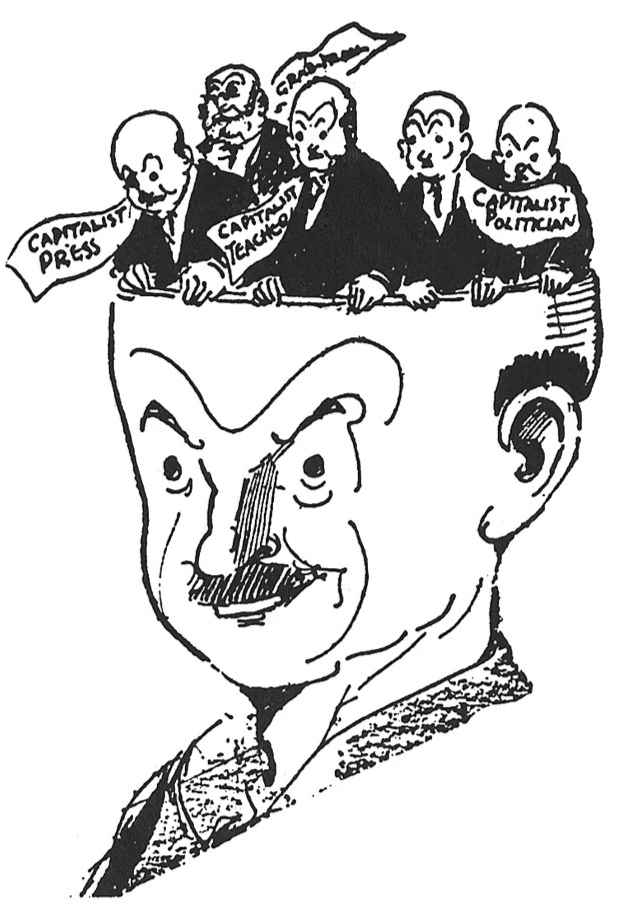
"Who does your thinking for you?"
Let The Members Lead
Read my bylaws amendment R7 here. A bylaws amendment that put the direction of the chapter back in the hands of the rank and file members. Let me tell you why that's important.
Why did you join DSA? I joined DSA in the summer of 2021, after feeling the crushing weight of capitalism right out of college. The job market sucked, and I had just spent a lot of time looking for work. I had grown up in trailer parks across multiple counties and in multiple townships throughout rural Michigan. But no matter where I went, the story was the same, businesses and landlords taking advantage of working class people . I knew there had to be something different but didn't know where to look.
If you're like me, you joined DSA because we don't get to experience democratic control anywhere in our lives. We want to feel like our thoughts and ideas are being heard. We want to feel like we have some say in the movement and direction of this organization. But honestly, how many of you are actually involved in the big decisions? How many of you know what things are being voted on in our leadership bodies’ meetings? It's hard to keep up to date. There are a million meetings; we can't be everywhere at once. But that doesn’t mean you shouldn’t still be involved in democracy.
We say we are a member-led, member-run, member-funded organization. That the ideas and direction of this chapter should come from us. We elect a leadership body, the Steering Committee (SC), which we want to take our concerns, our tactics, our thoughts, and exemplify them to the highest order. An organization like DSA works best when the membership and leadership are working together toward a shared goal. In its worst case, leadership is divorced from the wants and needs of a growing organization, standing in the way of the will of the membership. When an organization devolves to the members simply following the direction of the leadership, we have a stagnant organization that will not build the skills, base, or power to be able to change this country. It becomes a top-down mobilizing organization similar to the Democrats.
In the manual Democracy Is Power, Martha Gruelle and Mike Parker write: “Top-down mobilizing tends to be inflexible, to say, ‘Here are the steps. Follow them.’ … Members are often enthusiastic when first invited to get involved in [mobilizing-type] actions. But they may have their own ideas about effective tactics or timing. If they’re not allowed some say in the new actions, they’ll eventually vote with their feet. If enough members are turned off this way, the actions fail. In the long term, top-down mobilizing does not develop new leaders. Nor is it the best way to get members to volunteer to organize new workplaces; how inspired can you be about your union if you have no say in it yourself?” We could say the same about DSA.
The Current Balance
At present we have a chapter that is heavily top-down mobilized. The SC acts as though they have final say. Their meeting minutes do not accurately reflect what is said or how SC members voted. The SC endorses an action and expects you to participate. They set a new rule and expect you to follow it without question.
We see this no more clearly than at the recent March General Meeting (GM). The war with Iran had just started and some comrades informed leaders that they wanted to move to discuss it at the GM. Our leadership tried to discourage this by saying all items for the GM agenda needed to be submitted 10 days in advance. The war had just started 8 days prior. They said they would rule the motion out of order.
When we did manage to deliberate and vote on adding Iran to the agenda, didn’t it feel great? Keeping our chapter up to date with things that were happening? Educating new and veteran members, getting to know your comrades and their thoughts, building that sense of camaraderie? Our general meetings should be about deliberative discussion, education, and decisive voting of direction. Not a laundry list of announcements and updates.
So how do we return GMs to this deliberative body? One piece of it is returning democratic control to us. We should be discussing and debating the decisions made by our leadership body. We should be deciding whether or not we like the direction they are trying to steer us. We should counter anything we as a body do not like, refine what we do, and ratify anything we agree with. Because this is our chapter; we should act like it.
An Informed Deliberative Body
Our chapter already has this specified in our bylaws. I wrote my bylaws amendment as a way to return us to the way this organization was supposed to be run. Our bylaws specify in Article V Section 2:
“Section 2 Function, Powers and Duties. The Steering Committee is the executive body of MDDSA. All actions taken by the Steering Committee are subject to ratification or amendment by the membership at the next membership meeting at which quorum is reached, or at the membership convention if it constitutes the next membership meeting. The Steering Committee administers the affairs of MDDSA and oversees the implementation of the decisions of the membership convention and membership meetings.” That's right; all their decisions are subject to our final say. We already have this power, so I ask that we use it. I am asking that at each GM, you and I together decide what we want the future of this chapter to be. This is not unique to DSA. When a union negotiation team accepts a deal at the bargaining table, that's not where the negotiation ends. The negotiation team and leadership then must go to the members and ask for their approval, because it affects them. Because it is their contract, their union.
But how will we know whether or not we agree with what the SC has decided? It comes from being informed. If you look at past SC meeting minutes, they have not been representative of what has actually happened. They leave out comments from chairs threatening committees or branches autonomy. They leave out how each SC member has voted. (They started adding who voted how after I submitted this bylaws amendment.) It is quite hard to find SC minutes without looking through the Slack announcements channel, which deletes messages older than 90 days. My bylaws amendment makes sure that those in the room at our biggest meeting of the month are informed on what the leadership body of this chapter is doing, not just those who have time to attend the SC meetings.
We have this power; now let's use it. My bylaws amendment requires the SC to release a report of every decision made showing how each member voted. This is not currently required and the voting record was only made public after I submitted the bylaws amendment. Let's make it the standard. This report will be released 72 hours prior to the General Meeting, to allow members to read it ahead of time. Then, at the GM, any member may make a motion to approve, amend, or overturn any and all decisions. This can be a quick vote to ratify all decisions, barely taking more than a few minutes. But on the issues where we do disagree, the GM can return to its original purpose of being a deliberative body where we discuss the direction of our chapter.
A Better Future Is Possible
I didn't write my bylaws amendment to create bureaucracy, or slow anything down, or overturn the decisions of anyone. I made this bylaws amendment because I believe in you. I believe in this organization. I want to hear your thoughts, ideas, tactics, and disagreements. I believe we can decide together what is right for us and our chapter. This mechanism will help to allow issues to be voiced. To allow these issues to be discussed openly.
I made a deal with myself that I wasn't going to bring this bylaws amendment forward unless I could find new members who thought this was a good idea. During these conversations with new members I consistently got one response, “Why isn't this already a thing? This is why I joined DSA. I want to be involved.” Those members are what led this bylaws amendment to be in front of you. Thank you to those comrades. Just like I put my own opinions aside and wanted to hear from the members what they thought, so too should the leadership of this organization. For us to actually fight the powers of capital and become the organization that all of us wanted to join, we must practice what we say we want our society to be. We say a better future is possible—then let's start here in Metro Detroit DSA by listening to our members. An organization where leadership means only being the people at the front of the room will fail to make this change.
Let's let the members lead.
Vote YES on R7
Collin P. - a member of the Detroit Democracy Coalition, a new self-organized, cross-tendency formation