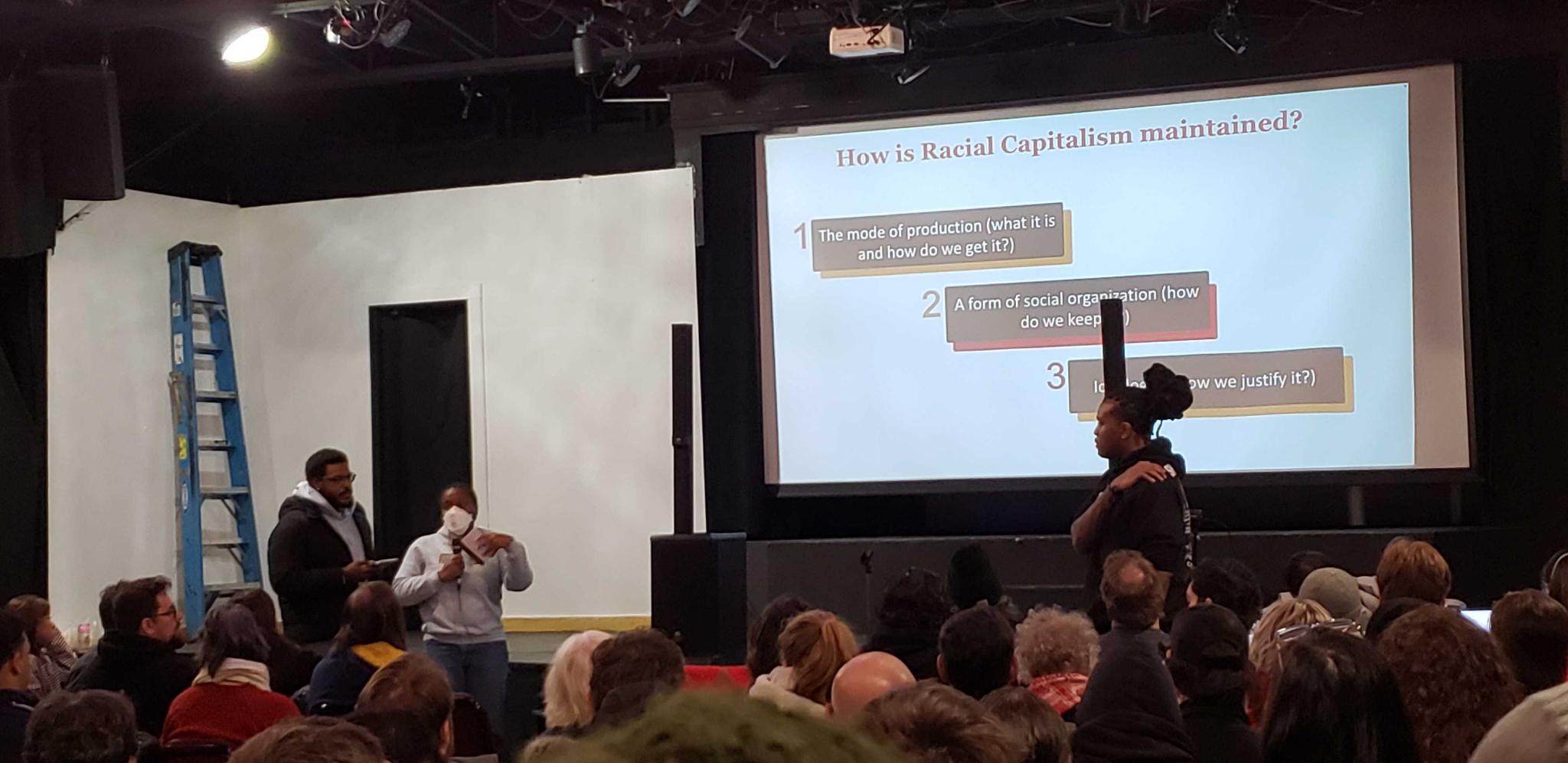
Comrades Rodney C., Alyson G., and Jon M. presenting a General Meeting educational segment on "Racial Capitalism"
Political Education at our Monthly General Meetings
Committees in DSA allow members to focus their work on specific areas. Their primary goal is supporting the chapter as a whole, and their members and decisions are accountable to decisions made by the membership of the chapter. Our chapter’s Political Education Committee (Pol Ed) is “responsible for coordination of political education events for the chapter.” Education is a top priority of Detroit DSA, and Pol Ed takes that responsibility very seriously. The resolutions the committee brings to the 2026 convention are based on two years of dedication and experimentation on a particular project. Here’s some of that history in brief.
FOCUS & EXPERIMENTATION
Two years ago, members of the Pol Ed committee brought an amendment to their base resolution dedicating 30-45 minutes of every monthly General Membership meeting (GM) to political education. The reasoning was simple: As the most important space for our chapter, the GM deserved our attention. We would bring an array of socialist education topics over the course of the next year.
By presenting this as a separate amendment, Pol Ed hoped to spark an engaging debate to convention on the importance of education. However, the idea was so well received that only one member spoke against it (beginning with the caveat that their remarks were not really “against”). The amendment passed by an overwhelming majority (only 8 nays).
The committee developed and presented ten GM topics in as many months. The work was spread across the committee, with ten different leaders organizing the effort each month. We had a broad range of topics:
- Four on chapter projects or campaigns
- Four on current events or history
- One socialism 101 topic
- One national DSA project
Over the course of 2024 we also organized four Red Squares, multiple monthly reading groups, lectures, trainings, and movie nights. Each of these different venues provided a different context for our work, with varying strengths and weaknesses. We began to think about the best venue for different kinds of topics, and how different methods of presentation affect the way members engage with the information. The committee debriefed following each presentation or event, and through those conversations we also realized we needed more planning time for each topic.
At the 2025 convention, we reaffirmed our focus with a second resolution ,which was included in the Consent Agenda. Soon after, the committee adopted a motion to focus half of our GM topics over the next year on Socialism 101, topics of perennial importance to the history and development of socialist organizing and our class politics:
- Why We’re Socialists
- Why the Working Class
- Racial Capitalism
- Socialist Feminism and the Patriarchy
- Why a Socialist Organization
At the time, a huge influx of new members/seekers were joining our monthly meetings with a wide variety of backgrounds and political experience. Our intention was to help all members grow their confidence speaking to what socialism means and why it provides the necessary political framework for addressing the issues that millions face. With a syllabus of five topics, we left the alternate months open for current events or suggestions from members outside of the committee.
In addition to the Socialism 101 topics, we presented a panel of local Palestinian activists, a history of “sewer socialism,” and collaborated with our chapter’s Black & Brown Alliance (BBA) to bring a guest speaker on imperialism (unfortunately the speaker had to cancel due to illness, and a replacement discussion on ICE was cut from the agenda).
The commitment to a syllabus allowed us to spend more time developing each topic (preparations often began two months ahead), and to organize new and experienced members to the planning groups. That additional time also allowed us to work with members outside of the committee, focusing especially on collaborations with BBA leadership and our chapter’s Steering Committee (SC), who all expressed interest in the project.
WHAT COMES NEXT?
For the 2026 convention, the Political Education Committee developed three resolutions that fit together to form a comprehensive syllabus covering the basics of socialism, DSA's strategy, and an overall vision for our GMs:
- R4-26 Political Education Committee Resolution, which now includes the five socialism 101 topics
- R16-26 General Membership Meetings Pol Ed Series on Debates in DSA, a proposal for a series of debates in the months alternating the 101 topics >
- A1-R8-26: Agitation, Deliberation, Education: A Radically Democratic General Meeting , (formerly a resolution—through reasons outside of our control this became an amendment) an overall vision for how we spend our time at each GM, including a process for responding to current events
This suggested syllabus is based on two years of preparation, experimentation, and feedback. MDDSA members are encouraged to volunteer to work collectively on any topic. Our meetings are open to all members, and we meet twice a month, alternating between in person and online to accommodate differing schedules and availabilities.
Committing to a syllabus does not mean Pol Ed can’t also do other things. We have an amendment that allows for flexibility should the horrors of life in the twenty-first century demand our attention (as they so often do these days). We have Red Squares open to a wide variety of topics, and the ability to run as many as membership-power allows. We have an on-going organizing school where members can learn a wide-variety of organizing skills.
And because the basics of socialism form the building blocks for every socialist campaign, they are inherently related to the work that we do in the world and can be continually tailored to meet the moment. We need deep conversations, repeated over time with new and old members, about systematic forms of oppression (racism, patriarchy, and capitalism) because those conversations inform our strategy in our campaigns, projects, and workplaces. Socialists must be strategic in order to make real systemic change. It is through conversations about the basics that we can start to recognize the systems we are fighting.
Amanda Matyas is co-chair of Detroit DSA’s Political Education Committee. She is also a member of the national Bread & Roses caucus and the local Democracy Coalition, a new self-organized, cross-tendency formation.